Agnes Wenham – Paediatric Pioneer
Agnes Wenham, a physiotherapist who trained in Sweden and England, was a well-known character in the profession, especially in Johannesburg, where she practised for many years. She moved to South Africa from the United Kingdom as a young woman and worked in the field of paediatric physiotherapy from 1938 to 2013, the year in which she died.
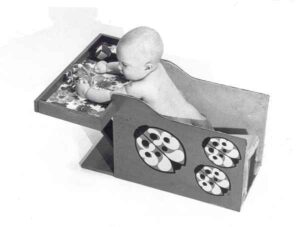
In the Front Support Kneeler the baby learns to dissociate flexion of the hip from flexion of the spine.
Wenham designed “simple gymnastic equipment on orthopaedic principles” which she exhibited at many international congresses for physiotherapists and orthopaedic and sports medicine physicians. Her range of Orthotoys for infants through to older children are adaptive, orthopaedic-based toys and equipment designed to promote good posture, mobility and sensory development. Items include stepping stones, prone boards, seat wedges, and balance beams. They are commonly used in paediatric therapy, classrooms, and homes to assist children with motor control and stability. A range are available for viewing at her website at www.agneswenham.com.
Wenham showed a film on her Orthotoys at the Physiotherapy World Congress in Copenhagen in 1963. She subsequently travelled throughout Europe making contact with other interested persons. Copenhagen television made a copy of the film and it was shown at Great Ormonde Street Hospital for Children, London; also at the Royal National Orthopaedic Hospital, London.
Wenham developed her own “baby gymnastics” which was inspired by the work of Friedrich Wilhelm Detleff Ehrgott Neumann-Neurode, a pioneering German paediatric physiotherapist who had died in 1945.
In 1965, after being invited to present and show a film on her work to Professor Josep Trueta, then Professor of Orthopaedic Surgery at the University of Oxford, Wenham (1966) also visited Dr and Mrs Bobath at their Private Clinic at St John’s Wood, London, and showed her film to these luminaries of physiotherapy too. As was typical of her, she was confident but humble about her work, saying,
Its message was nothing new to them. They knew much about the late Neumann-Neurode’s work and I noticed his booklet on a desk. What made them so thrilled about the babies at work in my film, I do not know. I just heard delighted remarks by Mrs Bobath about certain points and then a final: “I can see this must be learned properly. We need it for our atonic babies. You must let me know when you give a first course on baby gymnastics in London.”
Dr. Bobath quietly added that, if I ever contemplated another film on babies, he would gladly make it. I was overwhelmed by such acknowledgement and support. What is more, I was moved that the wish to learn the exercises came from a person who was already known throughout the world for his skill in handling notoriously difficult spastic babies.
In her later years, Wenham focused on babies in Johannesburg orphanages where there were so many at the time, largely because of babies being born to mothers who died of HIV/AIDS, but just too few staff to give them the emotional care they needed. In December 2004, Wenham wrote,
When you look at these babies, they are touchingly sweet and beautiful. What strikes you as a little unusual is the lengthy look at you, pointedly, searchingly, wondering whether you might be the mother they so desperately need. When I assessed these babies before giving them baby exercises, I was struck by the fact that they were all (practically 80%) quite unusually stiff. In the three homes I have worked [in] to date, I could only half-lift their little arms, their hands were, most of the time, fisted, the legs often unusually crossed and stiff. Because all the babies were judged as medically healthy, their muscles could only be tight from the agony of missing their mothers.
Wenham advocated for investment in care for orphaned babies to prevent future health problems, both physical and mental. These babies were almost invariably behind on all their developmental milestones. As she pointed out, they weighed less, smiled less, moved less and babbled less than their peers: “We can’t undo the loss of parents, but we can and must give deeply troubled infants the therapeutic and encouraging attention they urgently need.”
Agnes Wenham is a woman worth honouring. She was a deeply committed paediatric physiotherapist whose passion meant she worked almost to the last day of her life.
Acknowledgement: Author Mandi Smallhorne for the History Book of The South African Society of Physiotherapy.
References
Wenham A. (1966). Child physiotherapy. South African Journal of Physiotherapy, 22(4), 8-10.